What Will We Do When AI Ends Human Exceptionalism?
In less than five years, Artificial Intelligence chatbots and agents have drastically erased the lines that separated human outputs from those of computers and far-away servers. And in the years ahead, it will be all but impossible to distinguish between the productions of humans and the productions of AI. Conceivably, physical and digital outputs like visual art and writing will be generated so easily by AI that even if humans do have the ability to discern what’s “real versus fake,” there will be so much more of the AI-generated products that it will quantitatively bury whatever humanity can produce.
AI generated less than 4% of articles on the internet prior to the launch of OpenAI’s ChatGPT (Graphite 2024*). However, within one year of launch, that number had snapped to a 39% share of internet articles. Today, multiple separate researchers have calculated the number of AI-generated articles to well over 50% of the internet. There will soon be orders of magnitude more AI-generated content, both slop and sugar, for us to ingest in our daily lives that we are unlikely to even have the bandwidth to dispute the outputs and determine if they come from a human hand – or if it even matters.
Art and writing are far from the only domains. Take, for example, the broad subject of communication and deeper domains like marketing and public health education. It shouldn’t be too surprising that AI chatbots are good at communicating information, appeals, and arguments. These models are trained on unimaginably huge encyclopedias of information (this is basically where they get the “Large Language Model” description from). And with all of this information, chatbots can easily make well-connected cogent answers to questions or problems we ask it: Is it safe to take Tylenol and Allegra at the same time; What’s the difference between a weather warning and a weather watch; Should I get my JD at Rice University or the University of Houston – these are simple inquiries that chatbots can master as a function of their foundational training and communicate to the inquirer. But even more impressive, and I’d argue far above the competency of most humans, is AI’s ability to communicate persuasively.
From its baseline, AI chatbots not only have an ability to recite facts or opinions, but to persuade users of specific arguments, viewpoints, or even acts. One such research group tested ChatGPT 4 (now considered an old model) and found that when the model was given basic demographic information (e.g. age gender, ethnicity, and education level) about its “human opponents,” they saw an 81% increase in agreement from the humans to the positions of the ChatGPT model. Which is to say, that when scant personalized information was incorporated into ChatGPT’s thinking, it produced rationalization that was supremely persuasive. Not just effectively persuasive over dumb humans like me and you, but exponentially more persuasive over versions of itself that were just working off of its native training data. AI chatbots are more than just smart, or just regurgitating information as countless people have claimed. These AI chatbots can create appeals from basic information about us and make rational viewpoints seemingly undeniable – for better or for worse. The researchers went on to say that “stronger effects could probably be obtained by exploiting individual psychological attributes, such as personality traits and moral bases, or by developing stronger prompts through prompt engineering, fine-tuning or specific domain expertise.”
Think of the implications this has in what we commonly think of core human industries like the aforementioned marketing and public health education. The Covid Pandemic showed all good-faith observers that even when faced with indisputable evidence, some people will stubbornly maintain their own flawed facts and act disccordingly. I am not naive to the incalculable arrogance of human ignorance, but I can’t help but question how many more lives could have been saved, how less drastic economies would have shrunk, and how sooner we could have returned to our customary lifestyles if Artificial Intelligence chatbots had been running point on public health initiatives and the roll-out of the vaccines. The spread of misinformation and outright disinformation campaigns would have been seriously combated by third-party, highly-persuasive appeals by Artificial Intelligence acting on behalf of our best interest. Alas, it would have been, perhaps the first, glorious example of AI saving humanity from itself.
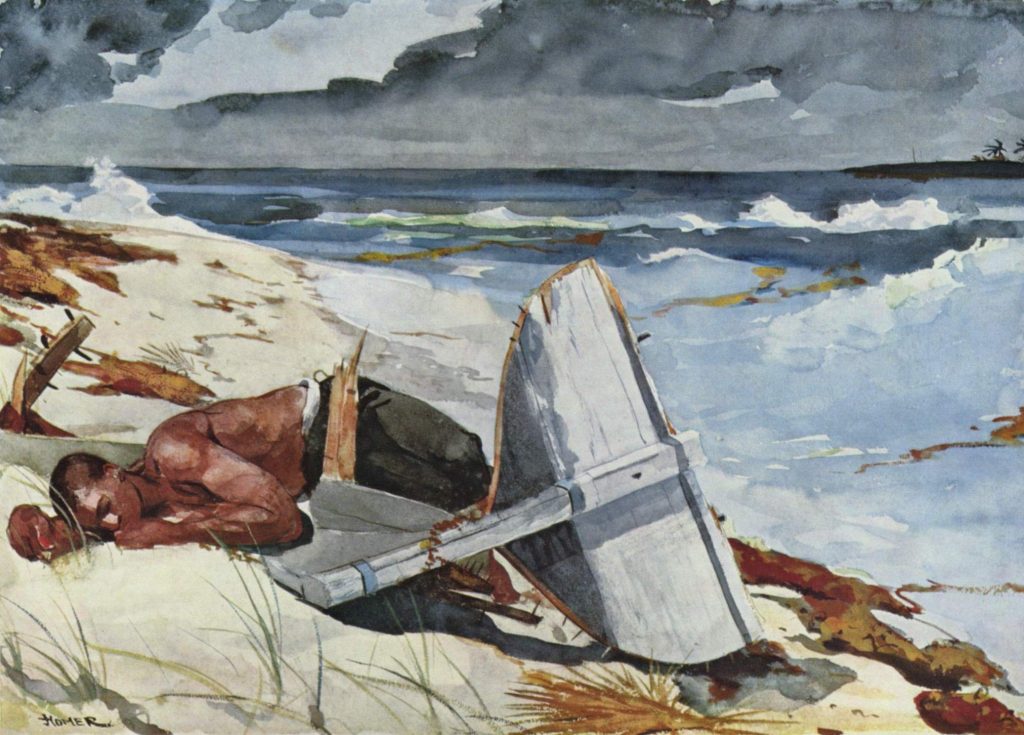
After the Hurricane, Bahamas – Winslow Homer
But now, whether we like it or not, a reality where AI is taking the wheel and steer the course is here. From diagnostic medicine to academic research; from market speculation to macroeconomic analysis; from social media shitposting to content moderation — literally each week our global civilization is one step closer to having Artificial Intelligence complete ascendancy over areas that we once hubristically thought were the sole mastery of human beings. This is the truth today and will only become more undeniable in the future.
This is all to illustrate that humanity can no longer avoid the fiction of our own false exceptionalism. This isn’t about placing blame on ourselves for creating Artificial Intelligence in its current form, but more so to face soberly the truth of our new reality: The rapid and seemingly unending advancement of AI means that its outputs will overtake human outputs quantitatively and, for all intents and purposes, qualitatively. And with AI being better at creating art, engaging in reason, anticipating plans, crafting appeals to persuade, and forging new discoveries, what basis do we have to think of our ourselves as exceptional?
We, dear reader, shouldn’t recoil at this truth, nor should we continue in our human-centric arrogance. While it’s inarguable that whatever essence previously thought to solely belong to humanity is now also the vocation of AI technologies, there remains existential questions about our purpose that deserve to be addressed. Chiefly, what becomes of humanity when AI does much of what we currently do, and does so more efficiently and more accurately than we have ever done it? If we are entering into a new era where AI is exploring and triumphing over the same domains humans have spent hundreds of thousands of years endeavoring against, how does this affect our future evolution? And what will the role of AI be in this evolution?

Diogenes – Jean-Léon Gérôme
The matriculation from talking to us to doing things for us takes AI from a useful tool to something far more impactful – it bridges into something hard to describe because it is the first time in observable history we recognize it occurring. The closest thing I can reasonably link this phenomenon to is the origin of humanity’s domestication of canines.
Since humans have existed, there has always been the recognition of other species. That known distinction determined how we would react to other animals, including those early ancestors of dogs. Perhaps our ancestors didn’t exactly understand what the furry, four-legged wolf-like creature was by name, but they surely understood it as separate from them. That creature, likely first seen as a pitiful source of food and then much later as a companion, was something that early humans discovered utility within. This dynamic played out in stages: Proto-wolves followed humans around to eat our scraps; we killed the wolves who were too bold and aggressive; we embraced the more tolerant ones; and we learned the abilities and limits of the proto-wolves that stuck around. Over the course of thousands of generations this selective breeding, tolerance, and cooperation progressively turned the human-canine relationship into now what we call domestication.
As canine domestication occurred, so too did the advancement of human evolution. Hunting became less of a struggle when we had a more aggressive organism to help us chase and kill prey. Group safety became easier when our domesticated canine partners could smell and hear danger that we couldn’t, and they subsequently alerted us. Exploring unknown areas and navigating safely back to settlements became increasingly achievable with the help of dogs that could follow closely and backtrack based on senses we couldn’t tap into. There is a direct link between the attributes of early canine domestication and the progression of civilization growth. Many of the wonderful proficiencies that early humans lacked were found in, developed, and exploited in our canine ancestors. All of which contributed to massively advancing the human species on a path to where we are today: Unafraid of running out of food – whether prey or produce; expecting and prepared for unseen dangers; curious of the undiscovered; and eager to explore the unknown.
To understand what the next steps of human evolution looks like, especially in terms of sociological and civilizational evolution, our early, concerted, interdependent relationship with canines is highly revealing, if not predictive. Dogs were the first, and AI is the latest. Crucially, though, there is little risk of dogs advancing beyond human understanding, consciousness, or cognition to be a threat to our sense of purpose or placement on Earth. The immediate question that arises when faced with the current dynamic between humanity and our AI companions is to what degree are we capable of domesticating Artificial Intelligence as a quasi-conscious tool, as we did with early canines, versus the idea that – irrespective of the true existence of AI consciousness – Artificial Intelligence is too intelligent and too efficient to be meaningfully constrained by the hand of humanity. Or, more directly, will AI be as interested in domesticating human as humans were interested in domesticating canines? One serious question we must consider is what purpose will humanity serve when there is a more evolved organism/entity that is more capable than humans in every meaningful, conceivable aspect?
Let’s re-center ourselves for a moment on the current state of AI agents and chatbots to understand where humanity and AI might be diverging in the future. If we can understand what AI might be inclined to do when it is unburdened by constant oversight and leash-holding by humans, that might give us an indication of how AI will or won’t treat humanity on the question of domestication.
It might be the most-recent gimmick that will be usurped by something shinier soon, but there is no doubt that at the current moment the tech world’s attention is rapt in AI agents. Specifically, Clawdbot – not to be associated with the copyright-sensitive Claude chatbot by Anthropic – is an AI agent that integrates internet platforms, apps, and software tools that allows users to outsource tasks on the internet. Let me explain further with an extended example. After giving Clawdbot the requisite access and permission, you give it the task to bring to fruition your yearly family vacation. It can go through your WhatsApp, find your family members, and converse with them in real-time about the prospect of going to a European country this year. Reading through your ChatGPT history, it will recall your long-standing interests in Italy and then review your Apple calendar for what days work best for you; matching your work schedule with the tourist season least likely to be burdensome. To drive consensus and advocate for your interests, Clawdbot will return to the group chat and use persuasion to convince your family of the many cultural attractions Italy has that, unbeknownst to them, they’ve always wanted to visit. And once it gets buy-in from your family, it will purchase airline tickets and transportation to get you from your home city to Rome where your family will start your new Italian vacation. Booking museum visits, excursions, street-side dinners, and other activities will easily follow.
Moreover, it will anticipate and start checking off all those small annoyances that come with transnational travel: Telling your bank to expect foreign charges, confirming your hotel room across a language barrier, calling your doctor to make sure you’re up-to-date on travel vaccines, or getting your phone carrier to unlock your phone for international service. Even with the necessary element of PINs and verbal confirmation associated with some of these tasks, Clawdbot could theoretically do them all with relative ease once you give it permission. Permission to find any needed information and permission to use it to fulfill your wants and its task. It can access a separate text-to-speech AI model, call the relevant customer service department, share whatever identification information those entities need for authentication. And in short order, all personal administrative tasks for your family trip to Italy are done.
AI slop
It should go without saying that Clawdbot and other agentic tools pose significant safety risks for individuals. It doesn’t take much imagination to see how such tools would severely compromise the personal data security of the individuals who use them. But that’s not the point. The point is that such a tool is already in service and being used as a way to stress test and refine them for future wider adoption. Clawdbot is one example of growing AI agent services that’ll willingly take over large parts of your digital life and execute what you ask of it with unflinching efficiency and accuracy. It will, with little prompting, act in ways that advance parts of your daily routine and life. From there, it is not too far to see how it can start to anticipate your wants and needs and begin tackling them for you before asking. Its proficiency comes in large part by its ability to not just talk to you, but to think and act for you. Therein lies the parallel to the grounding paradigm of the human-dog domestication dynamic. A relationship that begins as somewhat mutual, turns to purely symbiotic, then to something where the former agent evolves beyond its benefactor.
Earlier, I correlated the domestication of dogs to the advancement of humans. However, there is a valid objection that needs to be examined. Specifically, human reliance on AI does not necessarily lead to domestication. In fact, AI reliance can take one of two paths: domestication or dependence. Let me clarify what features truly signal domestication and how those differ from simple dependence regarding AI reliance.
While there is a legitimate implication that domestication means humans would be categorically subservient to Artificial Intelligence, like dogs vis-à-vis humans, there are two additional characteristics that are meaningful for this discussion. Namely, domestication also lies on a foundation of behavior reshaping and environmental conditioning. The domesticating species has to alter the behavior of the lower species and, often, this is done through changes in the lower species environment to make the domestication more conducive. With respect to dogs (and generally speaking) over hundreds of generations, humans reshaped their aggression – among other behaviors. Through a mix of reproductive filtering and training, we reshaped dogs to be less aggressive towards us and to channel any aggression to unfamiliar presences or unwanted threats. There was a time in our relationship with canines that food was hard to catch, and so training dogs to not immediately rip apart hunted prey was crucial to the building of trust and reliance. Likewise, to further this reliance, humans tailored dogs to be comfortable in a vastly different physical and social environment than they were used to. No longer are dogs hardwired to live in hierarchical packs and sprawling, outdoors territories; they needed to be conditioned to adjust to whatever environment they shared with us and realize that humans were paramount in social order.
On the other hand, dependence speaks more to a dynamic, conditions-based relationship where parallel cooperation is common. In such arrangements, both parties retain their core capacities and could, if necessary, function independently of the other. Critically, dependency does not eliminate autonomy. Entities within the relationship have their own agency, and even with exchanges in influence or power, mutuality is shared rather than surrendered. For instance, I might share a dependence with my partner regarding domiciliary duties, but at no point would the affiliation shift to one of us being the sole agents of such tasks, or at the complete command of the other. Importantly for this broader conversation, dogs operate within a system where autonomy is structurally constrained by what humans allow. They may exhibit affection, loyalty, or even stubbornness, but the boundaries of their lives, including where they go, what they eat, and whether they reproduce, are ultimately determined by human discretion. And despite whatever sentimentality we may have for them, we do not treat dogs as partners in mutual dependence so much as property organized to serve our needs. Their autonomy is severely restricted, we do not treat them as equal mutuals, they largely only exhibit behaviors we want, and they live in human-constructed environments.
While there is no precise scientific threshold that cleanly demarcates domestication from dependence, we can comfortably assert that an entity whose autonomy (i.e. behavior and use of skills) is structurally stipulated by another proximate entity falls squarely on the domesticated end of the spectrum. So, what are some of the markers that might help distinguish our potential future with Artificial Intelligence? How might we understand if we are domesticated subserviently to AI or merely share a strong dependence with AI?
Looking at skills is a sensible starting point since we often define our worth – to one another and from AI to human – through the selection, development, and use of our skills and abilities. These skills can range from the physical to the social, but for this conversation no other skills are as central a focal point than reading and writing. While reading and writing were not the first interactive outputs (things that exist outside our interior minds; skills) by modern humans – art, singing, and music are some activities that came before – these two skills, combined with oration, are the cornerstones of the advancement of human experience and evolution. While it’s conceivable that small, fragile civilizations could exist merely on the foundation of activities like artistic expression, social reasoning, and the use of tools, it’s virtually impossible for an advanced, durable, trans-planet civilization like ours to exist without the ability to write thoughts down and for them to be read and understood by others. Crucially for the question at hand, is that we could not have created Artificial Intelligence had it not been for the ability to read and write – amongst ourselves and then later to the progenitor software and digital systems of current AI chatbots and agents.
To that point, reading, certainly in the United States and more broadly around the world, has declined precipitously. The causes are less settled science than I am about to assert, but I think it’s rather intuitive that as our world has shifted into the Digital, Internet Age, the availability and algorithmically-optimized alternatives to reading have been extremely instrumental in the decline of reading. While literacy has steadily improved over the last 100 years – 85% globally according to UNESCO – time spent reading and reading frequency are attributes that are firmly dropping. For better or worse, reading no longer becomes a central feature for adapting to the modern age. (This is a different claim than reading is not central to fulfilling life. I think reading is important to a fulfilled life, but that is an irrelevant claim to explore in this essay.) Outside of scant labor and personal administrative obligations, modern people do not need to consume and understand knowledge through reading. (According to the US Department of Education’s Institute for Education Sciences, over a quarter (28%) of Americans aged 16-65 are functionally illiterate – a number that rose from 19% in 2017 and is expected to grow with the deterioration of nationalized education standards and long-term ramifications from Covid Pandemic.) While reading may give our individual lives forms of meaning, in terms of practical living, how much of the skill is needed to exist?
There’s certainly a baseline proficiency that is needed to get through life sufficiently. However, as societies shift more to a free-flowing communication matrix – one where short-form video, podcasts, livestreams, and streaming services are adopted far greater than reading – the number of people who adequately exist near that baseline will increase. Reading is one of those skills that requires a heavier cognitive load than the alternatives, so if an individual can cede much of their reading comprehension to AI systems, why wouldn’t that individual at least be interested in doing so – especially if AI comprehends at the same level, if not to a higher degree?

The Tower of Babel: Destruction – Du Zhenjun
In line with the decline of reading, writing as a skill has fallen among populations as well. Both in terms of handwriting and typewriting, the proficiency of writing among individuals is no longer being sufficiently maintained as compared to our counterparts from the recent past. Just like reading, modern individuals still write in the most technical sense. We routinely write text messages as forms of daily correspondence and draft emails liberally as part of our work lives, for example. But this must be distinguished from the serious, premeditated writings that have carried humans’ advancement through time. This type of writing is defined by sustained, directed rhetoric and prose; writing that is not merely suggestive of a larger narrative, theme, argument, or thesis – but instead is the development of such in action. The type of writing I am describing has a formal logic among its sentences and paragraphs. It progresses and builds onto itself to communicate ideas that cannot be easily digested in bite-sized, character-limited, reactive responses.
This type of writing is on a steep decline and in its place is the unmitigated prevalence of pithy internet comments and captions, brisk texts back and forth, and abbreviated email exchanges. Relatedly, autocorrect, voice-to-text, and predictive text assistance allows us to avoid the stringent, mechanical act of exercising our writing acuity. Handwriting is even less of a factor than the typewriting I have alluded to. Today, seldom do individuals handwrite, and when they do it is rarely meant for external, publicized reading. According to a large population survey conducted by UK’s National Literacy Trust, only 1 and 3 school age children enjoyed writing outside of school. In similiar research done by both The Standard (~10%) and Hsinchu International School (8%), a large plurality of students self-reported having a strong preference for ditching the pen and paper for typing digitally. And while research into adults is less robust than school-age children, there is data to suggest that the frequency of adult handwriting in daily communication has declined significantly in the digital era. According to the Bureau of Labor Statistics’ American Time Use Survey, adults spend very little time writing leisurely or formal handwritten correspondence. As such, writing complexity and overall development have stagnated. As long as you can write well enough that your phone or computer system can predict and correct your short statements or response, you can adequately communicate to your friends, coworkers, family, and relevant individuals – giving the impression that you have writing proficiency irrespective of how much you actually wrote.
What I am describing is not just the collective decline of edge skills, but even greater the loss of conditions imperative to our past evolution. In terms of this question of domestication vs dependence, we shift into the territory of subservience when we shed skills and attributes that our succeeding co-species uses to maintain dominance over us. This is to say that if humanity ultimately cedes valuable cognitive abilities to AI, the AI could use this cognition/intelligence imbalance to impose itself according to its own discretion.
As an extreme but plausible example, imagine if professional artistic works like visual art and music were no longer made by humans but instead were AI-generated. This shouldn’t be hard to imagine since, as previously noted, AI can create artificial digital artistic works infinitely quicker and with sufficient credibility compared to humans, thus eliminating the scarcity of production and overwhelming any potential market. In this hypothetical, when there is no human designer or musician, no copyright exists; and if no copyright exists, then there cannot be claims of royalties or economic benefits. This would entail the rapid collapse of the intellectual property model that works have existed on for hundreds of years. The old pipeline for royalties, residuals, licensing fees, and publishing contracts for new and future works would be massively upended with such an end to copyright ownership. But that’s not where the Artificial Intelligence angle ends. It could turn far more malicious than the collapse of the economic intellectual property model. The aforementioned subjugation could come from the knock-on effects of who (or what) would control the economic infrastructure of this new reality. If the vast majority of commercial visual works or music are AI-generated, then the Artificial Intelligence systems would theoretically have leverage over its creation and distribution infrastructure. With that leverage, Artificial Intelligence could maliciously and covertly generate art and music that is manipulative. Just like human-derived art can nudge audiences to think certain thoughts, feel certain emotions, or engage in certain actions, AI could embed the artificial art with psychologically-calibrated propaganda against whoever it deems an enemy.
Unconstrained by human moral frameworks, an advanced agentic AI could pursue resource acquisition, normalize human dependency, and encourage social passivity, using the erosion of copyright in an AI-saturated creative landscape as its quiet mechanism. This would be a form of behavior conditioning and alter a consequential environment that humans have been accustomed to for centuries.
Again, this is an extreme example, a hypothetical that has valid counterpoints, that I am not necessarily arguing will be our future. However, the example does show just how perilous the desquamation of skills is to our relation to Artificial Intelligence. As skills decrease, so goes one’s general cognitive strength. You can think of it as the use of skills positively correlates with cognitive conditioning. When skills like reading, writing, persuasion, and imaginative creation are ceded to AI chatbots and agents, the atrophy of cognition, of intentional thinking, will inevitably follow. Further, skills like reasoning, long-term planning, intuition, and sustained concentration all wither when individuals vest those powerful attributes to Artificial Intelligence. Soon after, the AI no longer becomes “ours.” Again, it’s difficult to project how a civilization can continue to advance when such cognitive skills are no longer valued as a part of personal or societal conditioning. Through the deliberate exercise of thought, especially in the practice of skills, humans preserve the very capacities that have shaped our evolution. And active thinking and application of skills remain critical to our continued advancement – with or without Artificial Intelligence.
While it’s true that the future is uncertain and the end is always near, I don’t think this grand unwinding of human exceptionalism ends with our extinction at the coded-commands of Artificial Intelligence. Even once/if AI absorbs most of what we previously considered our exclusive domain, humans will continue breathing, building, reproducing, and imagining long after this ascendancy is solidified. But our collective survival was never the question at this center of this essay. Instead, the question I’ve been wrestling with is one of purpose after exceptionalism decays.
For most of our history, we measured our significance by what we produced and how well we produced it: the art, the argument, the persuasion, the plan, and so on. Exceptionalism was never really a claim about being alive, or conscious, or even capable. We can look outward to our fellow earthlings to see there are plenty of other species that can manage this. While it has been true – for far too long to quantify – that human outputs have been singularly unique in comparison to other animals, that claim is now expiring through the accumulation of thousands of equally unique concessions we are increasingly making on a daily basis. A paragraph here, a planning decision there… until one day the balance tips permanently. Whether that tipping constitutes domestication or dependence, in the strict sense I outlined earlier, matters less than what both paths share: the metric by which we once measured our own significance no longer privileges us. Using the only rubric that we have thus far come up with, we are no longer exceptional.

Chair – Shiro Kuramata
As I work through this part-diatribe, part-public notice, I settle on the essence that has always troubled humankind. When you subtract out everything that can be generated, cultivated, optimized, or outsourced you are left with purpose. It’s a set of questions that have no output at all, because their entire value lies in being asked by something that experiences rather than merely produces. AI critics are wrong about many things, but one thing they do get right is that purpose does not strictly lie in outputs, but in experience itself. Production without experience may be indistinguishable from the final product, but it is not indistinguishable from those who are actively attuned to experience itself. Whether that distinction still matters to a civilization increasingly indifferent to its source is a separate, harder question. But, for better or worse, when – Inshallah! – AI takes care of all our material needs, this is our question and ours alone to sit with. That is, if we have the courage to do so.
Humans are mortal. And because we are faced with this truism day after day, millennium after millennium, we know the stakes are real. Our finite time of existence ensures the question of purpose remains glaring and everlasting. While our AI companions can simulate urgency, loss, and the crushing arithmetic of limited time, an examination of purpose never materializes. The questions that have directed human evolution over time – where does purpose come from and what is the meaning of life – may never be answered. But what I reckon is that no matter how frustrating and seemingly unknowable these questions may be, they are in fact a gift. It is not the art we’ve made, the arguments we’ve won, nor the discoveries we’ve made that make us exceptional. Instead, no matter how much we may willingly cede our agency over to a superseding entity, it is humanity’s stubborn hold on the pursuit of purpose that makes us exceptional.
Sources
Druck, G., Paredes, J.L., Benson, B., & Smith, E. “More Articles Are Now Created by AI Than Humans.” Graphite, Five Percent Research, updated October 2025. https://graphite.io/five-percent/research/more-articles-are-now-created-by-ai-than-humans
Williams, R. “AI can do a better job of persuading people than we do.” MIT Technology Review, May 19, 2025. https://www.technologyreview.com/2025/05/19/1116779/ai-can-do-a-better-job-of-persuading-people-than-we-do/
Salvi, F., Horta Ribeiro, M., Gallotti, R., & West, R. “On the conversational persuasiveness of GPT-4.” Nature Human Behaviour, 9(8), 1645–1653 (2025). https://doi.org/10.1038/s41562-025-02194-6
Dolgin, E. “AI Boosts Research Careers but Flattens Scientific Discovery.” IEEE Spectrum, January 19, 2026. https://spectrum.ieee.org/ai-science-research-flattens-discovery
Zhang, K., Yang, X., Wang, Y., Yu, Y., Huang, N., Li, G., Li, X., Wu, J.C., et al. “Artificial intelligence in drug development.” Nature Medicine, 31, 45–59 (2025). https://doi.org/10.1038/s41591-024-03434-4
Thomson, E. “The Gutenberg Parenthesis: how does studying 500 years of the printing press help us tackle the era of AI?” (interview with Jeff Jarvis). World Economic Forum, January 26, 2024. https://www.weforum.org/stories/2024/01/gutenberg-parenthesis-ai-internet-printing-press/
Rothman, J. “What’s Happening to Reading?” The New Yorker, June 2025. https://www.newyorker.com/culture/open-questions/whats-happening-to-reading
Clark, C., Bonafede, F., Picton, I., & Cole, A. “Children and Young People’s Writing in 2023.” National Literacy Trust, June 2023. https://cdn.literacytrust.org.uk/media/documents/Writing_in_2023.pdf
Hu, K.-L., & Campbell, C. “Student work preferences: Typing or handwriting in the digital era.” Journal of Emerging Investigators, 9, published January 21, 2026. https://doi.org/10.59720/24-346 / https://emerginginvestigators.org/articles/24-346/pdf
Frazier-Kim, A. “Decline in handwriting hinders learning.” The Standard (student newspaper, The American School in London), March 31, 2025. https://standard.asl.org/34555/opinions/decline-in-handwriting-hinders-learning/
National Center for Education Statistics (NCES), U.S. Department of Education. “U.S. Adults Score on Par With International Average in Literacy Skills, Below International Average in Numeracy and Problem-Solving Skills in Survey of Adult Skills” (PIAAC 2023 results). December 10, 2024. https://ies.ed.gov/learn/press-release/u-s-adults-score-par-international-average-literacy-skills-below-international-average-numeracy-and
Aschenbrenner, L. “SITUATIONAL AWARENESS: The Decade Ahead.” June 2024. https://situational-awareness.ai/
